Most B2B podcasts fail quietly. They launch with a logo, a few episodes, and optimism—then stall when nobody can answer the CFO’s question: what is this actually generating? But the shows that get the strategy right don’t just build audiences; they build pipeline. This guide cuts through the noise and tells you what a B2B podcast really is, why the business case is stronger than ever in 2026, and what separates the shows that move deals from the ones that collect dust.
What Defines a B2B Podcast?
A B2B podcast is an audio (or video-audio) show built around a professional audience—typically buyers, practitioners, or decision-makers in a specific industry or function—with a strategic business goal behind it. It is not simply a podcast that talks about business topics. The “B2B” label means the show is designed to reach other businesses, advance commercial relationships, and serve a defined ideal customer profile (ICP).
The format can vary widely: interviews with practitioners, solo-host breakdowns, roundtables, serialized narratives, or hybrid shows mixing education with executive conversations. What defines a B2B podcast is its intent and audience, not its length or production style.
Three types of B2B podcast
The brand show: Owned and produced by a company. Guests are often customers, prospects, and industry voices. The host is typically an internal leader or hired talent. Examples: HubSpot’s podcast network, Gong’s Revenue Intelligence. Primary goal: thought leadership, brand trust, and inbound interest.
The demand generation show: Structured around a narrow ICP. Every episode maps to a buyer pain point; guests are often target accounts or ecosystem partners. Attribution is built in from episode one. Primary goal: sourced pipeline and guest-to-opportunity conversion.
The industry or practitioner show: Not branded to a single company but sponsored by one. The host operates as an independent voice, covering the category broadly. Primary goal: category-level authority and sponsor-attributed leads.
Understanding which type fits your goals is the first decision any founder or CMO needs to make—because the production model, distribution strategy, and success metrics are completely different for each.
The Business Case: Why B2B Brands Are Launching Shows in 2026
The numbers are no longer speculative. B2B podcasting has crossed the threshold from experimental to mainstream—and the companies still treating it as optional are watching competitors use it to close deals they never even knew existed.
The audience is already there
Globally, 584 million people listened to podcasts in 2025, and 55% of Americans are now monthly podcast consumers—the first time monthly consumption has reached the majority of adults in the U.S. Additionally, 75% of B2B decision-makers listen to podcasts, with 51% listening daily. In the U.S., 56% of monthly podcast listeners have a household income of $75,000 or more, making them a high-value demographic for B2B marketers.
Put simply: your buyers are already listening. The question is whether they’re listening to you or your competition.
The market is putting serious money behind it
Global podcast advertising spend is projected to hit $4.46 billion in 2025, with B2B-specific ads accounting for $4 billion of this. In 2025, 91% of marketers plan to maintain or expand their podcast and audio content investments. This is not a niche channel on the fringes of a content budget—it’s becoming a core line item in serious demand gen programs.
The pipeline data is real
Here’s where it gets specific. The average guest-to-client conversion rate on B2B podcasts is 10%, and one company converted 48% of strategically selected podcast guests from target accounts into pipeline opportunities.
A cybersecurity firm targeting Fortune 500 CISOs generated $2.3M in attributed pipeline within 9 months. Their approach wasn’t to chase audience growth—they systematically invited 24 target account executives as guests and converted 7 into active opportunities through strategic follow-up sequences. Average deal size: $328K.
One SaaS company discovered 47% of their enterprise deals had podcast touchpoints that traditional attribution missed entirely. This is the hidden ROI most teams never quantify—not because the value isn’t there, but because they’re measuring the wrong things.
Completion rates beat every other format
Top B2B podcasts maintain 60–70% consumption rates—meaning listeners stay engaged through most episodes. Branded podcasts achieve 90% completion rates versus just 12% for video content. No other B2B content format comes close to that depth of attention. A white paper gets skimmed. A webinar gets muted. A podcast episode gets listened to on a morning commute, start to finish.
But most shows still get it wrong
75% of B2B podcasts fail to demonstrate measurable ROI because they’re tracking the wrong metrics—downloads, rankings, and “brand awareness”—instead of pipeline influence, deal acceleration, and customer retention. The problem isn’t the medium. It’s the measurement strategy—or the complete absence of one.
8 B2B Podcasts That Actually Drive Pipeline
The best evidence for a B2B podcast is a B2B podcast that works. Each show below has built a clear strategic purpose, a defined audience, and a format that converts attention into action—not just downloads.
| Show | Host / Producer | Primary Audience | Format | Why It Works |
|---|---|---|---|---|
| Revenue Vitals (formerly State of Demand Gen) | Chris Walker / Refine Labs | Demand gen leaders, RevOps, CMOs | LinkedIn Live recordings + interviews | Challenges conventional B2B marketing wisdom, focusing on building predictable demand generation engines and questioning attribution models that marketing teams often accept without examination. Refine Labs turns the show into a direct pipeline channel for its agency. |
| Exit Five | Dave Gerhardt | B2B marketers, CMOs | Interviews, solo sessions, live Q&As | Exit Five offers a mix of formats. Dave Gerhardt brings the perspective of a former Drift CMO and community builder, which shapes the show’s focus on results-driven marketing rather than theory. It feeds a paid community that converts listeners to members. |
| Marketing Against the Grain | HubSpot CMO & SVP of Marketing | Forward-thinking B2B marketers | Co-hosted discussion, trend-led episodes | Hosted by HubSpot’s CMO and former SVP of Marketing, the podcast explores AI in marketing, social media platforms, content strategy shifts, and growth experiments. It serves as a flagship brand touchpoint for HubSpot’s entire ecosystem. |
| The B2B Playbook | George Coudounaris & Kevin Chen | B2B marketing teams, demand gen practitioners | Framework-driven co-host + interviews | The B2B Playbook shares a system—everything connects back to the 5 BEs Framework, a demand generation engine built for lean marketing teams who need to drive real pipeline, not just impressions. The show’s newsletter is trusted by 2,300+ B2B revenue professionals. |
| The Loop | Cognism (Alice de Courcy, Fran Langham, Liam Bartholomew) | Demand gen marketers, EMEA-focused teams | Interview-driven, practitioner-led | The Loop is produced by Cognism and brings together marketing leaders working on real demand generation challenges. Conversations are practical and direct, covering topics like breaking into new regions, localizing content, and building SEO programs tied to measurable revenue. It directly feeds Cognism’s inbound pipeline. |
| Revenue Builders | John McMahon & John Kaplan / Force Management | Sales leaders, CROs, revenue executives | Long-form interviews with sales veterans | Hosted by five-time CRO John McMahon and Force Management’s Co-Founder John Kaplan, the show goes behind the scenes with people who have been there and seen the results—covering best practices for scaling and growing a business while sharing pitfalls to avoid. It generates direct inbound leads for Force Management’s training programs. |
| Sales Pipeline Radio | Matt Heinz / Heinz Marketing | B2B sales and marketing leaders | Short-form interviews, pipeline-focused | Sales Pipeline Radio features the brightest minds in B2B sales and marketing, sharing secrets to driving greater volume, velocity, and conversion of sales pipelines across any industry. Heinz Marketing uses it as a consistent lead source for their consulting practice. |
| Full-Funnel B2B Marketing | Andrei Zinkevich & Vladimir Blagojevic / FullFunnel.io | B2B marketers, founders of tech companies | Deep-dive interviews, 60+ min episodes | Every week the hosts dive deeply into topics including B2B marketing strategy, full-funnel marketing, demand generation, lead nurturing, and account-based marketing. Rated 4.9/5 on Apple Podcasts, it directly drives consulting leads for FullFunnel.io. |
Notice the pattern: every show that drives measurable pipeline was built by people who also sell to their listeners. The podcast isn’t a hobby project running parallel to the business—it is the business development function, packaged as content.
When a B2B Podcast Makes Sense (and When It Doesn’t)
A podcast is not the right next move for every B2B company. Before committing budget and time, run your situation against these honest criteria.
Launch a podcast when:
You have a defined ICP you can reach through guests. The most reliable pipeline mechanism in B2B podcasting is the guest-to-opportunity conversion. If you can invite your 50 target accounts onto your show as guests, a podcast becomes a high-conversion business development tool. When one cybersecurity firm implemented a target-account guest strategy, they reached 78% of their target CISOs within 90 days, generating 14 qualified opportunities worth $1.2M in pipeline—without needing millions of downloads; they needed the right 39 listeners.
You have a subject matter expert (SME) who can host consistently. Audiences follow people, not logos. A great host with genuine domain expertise creates a show that’s hard to replicate. A rotating cast of internal talking heads usually fizzles within 12 episodes.
You’re playing a long-cycle, high-ACV sales game. B2B podcasts compound over time. They’re exceptional at building the trust and familiarity that helps complex, high-consideration deals close faster. If your average contract value is five or six figures, a single guest conversion can justify a year of production costs.
You can commit to at least 12 months of consistent publishing. Real B2B podcast ROI shows up in attributed pipeline, accelerated sales velocity, and measurable trust signals from your ICP. If you’re not seeing positive ROI within 6–12 months, your strategy needs surgery, not tweaks. But most shows that fail simply didn’t give it the time it needs to build compounding authority.
Skip the podcast (for now) when:
You don’t have a working attribution model. Launching a show without a mechanism to connect episodes to pipeline means you’ll spend 18 months guessing. One CMO told us they’d spent $180K on podcast production over 18 months with “probably some brand lift” to show for it. Attribution infrastructure needs to come first—or simultaneously.
Your ICP doesn’t consume audio content. Some technical buyers (hardware engineers, certain regulated industries) simply don’t use podcasts as a professional development channel. Verify the habit before investing in the format.
You need pipeline in the next 60 days. A podcast is a medium-to-long-term compounding channel. If you’re in a revenue emergency, invest in channels with faster feedback loops first—then build the podcast infrastructure once you have runway.
You want to publish twice a month with no promotion strategy. Poor distribution compounds the attribution problem. Publishing to Apple and Spotify isn’t a distribution strategy; it’s the bare minimum. A show that doesn’t reach your ICP is just expensive content production.
What It Takes to Launch and Sustain a B2B Show
Most teams underestimate production scope—not equipment needs, but operational load. Here’s what the work actually looks like, broken into the stages that matter.
Pre-launch (weeks 1–6)
Strategy comes first. Define your ICP listener, your show’s unique angle (not just “an industry podcast”), your host, episode format, episode cadence, and your attribution setup. Without a clear answer to “why would my exact buyer listen to this instead of the 50 other shows in our category?”, the show has no foundation.
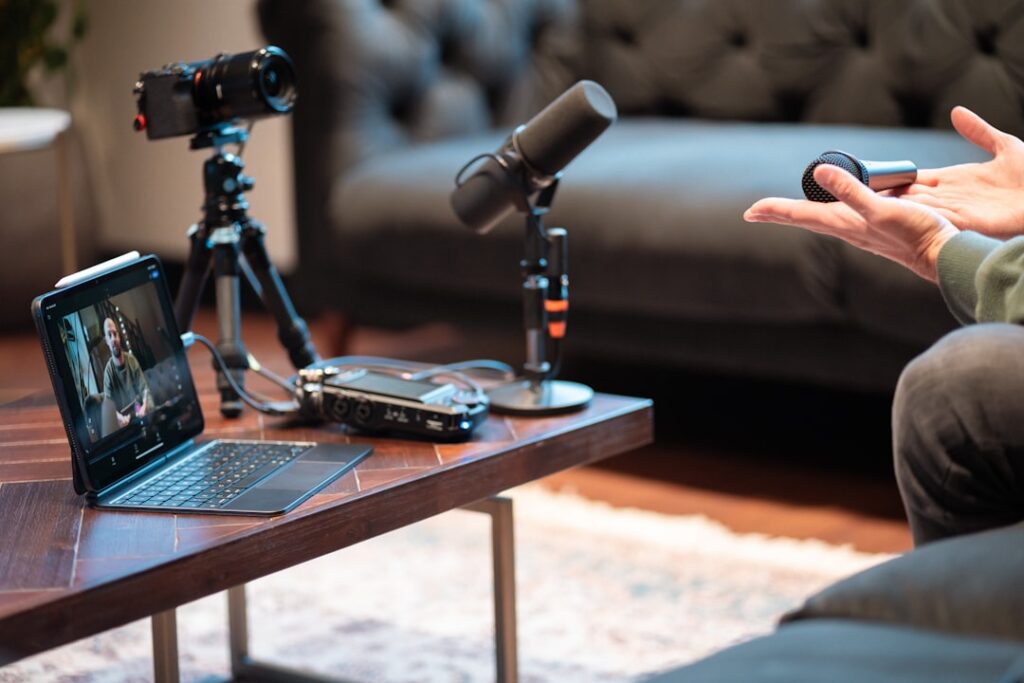
Equipment setup is the easy part. Initial equipment investment ranges from $500–$2,500 for a microphone, headphones, basic audio interface, and recording software. Monthly software subscriptions add another $50–$200 for a recording platform, editing software, and hosting service.
Guest booking and episode production
This is where operational reality hits hard. For a B2B company publishing weekly, guest booking alone can consume 100–200 hours monthly when done in-house. At executive opportunity cost rates, that’s $15,000–$40,000 in time investment before recording even begins.
Each episode also needs show notes, a transcript (important for SEO and AI discoverability), short-form clips for LinkedIn and YouTube, and a distribution push to your CRM segments. Top performers extract 10–15 assets from every recording: video clips, audiograms, quote cards, blog posts, email sequences, LinkedIn articles, and sales enablement materials.
Distribution and attribution
Publishing is not distributing. A sustainable B2B show needs a documented distribution workflow: guest amplification (their network is your biggest free channel), CRM-tagged episode links, LinkedIn organic promotion, email sequences to segmented lists, and ideally a unique landing page per episode that connects listener behavior to your marketing automation.
Every guest who appears on your show has a network of peers facing similar challenges. Creating guest amplification packages—pre-written LinkedIn posts, email templates, and 90-second video clips optimized for executive attention spans—makes sharing effortless. One SaaS client saw guest shares drive 3x more qualified traffic than their entire paid promotion budget, at zero additional cost.
Build In-House, Hire an Agency, or Outsource Production?

There’s no universally correct answer here—but there is a common mistake: conflating “podcast production” with “podcast strategy.” Many brands outsource the former while neglecting the latter, and end up with polished audio that generates zero pipeline.
The three models
Full in-house: You own everything—booking, recording, editing, distribution, analytics. Running a podcast in-house usually costs $1,000–$8,000 per month, depending on team size, tools, and production quality. The real cost is time. The 2025 Independent Podcaster Survey shows DIY podcasters spend 4–8 hours per episode on average, with 21% spending 9 or more hours per episode. For a founder or CMO, those hours have a steep opportunity cost.
Outsourced production only: You keep the strategy, hosting, and guest relationships in-house but hand off editing, show notes, distribution, and repurposing to a freelancer or boutique production shop. Budget services start at $500–$1,500 per episode for editing only; mid-tier packages run $1,500–$4,000 per episode and include production plus content assets. This is often the right starting point for teams that have a strong host but lack production bandwidth.
Full-service B2B podcast agency: The agency owns production, guest booking, strategy, distribution, and often attribution setup. Strategic or premium full-service retainers typically run $4,000–$10,000+ per month. An agency also provides strategic consistency—proven systems for guest booking, content planning, and promotion that protect your show from burnout and keep it on a consistent schedule. You get access to a team with experience producing dozens or hundreds of shows, who can help you avoid common mistakes.
How to choose
The honest filter: if your team cannot name the person who will own the show—not just contribute to it, but own it—then outsourcing is almost always the better path. Podcasts need the same focus and budget as any core marketing channel. Without a dedicated owner or agency partner, production gets inconsistent and results disappear. Commit to it like you would a webinar series or an outbound campaign.
Looking for vetted production partners and agency options? At podcastagencyreview, we review and compare the leading B2B podcast agencies so you can shortlist options with confidence—without spending weeks on research calls. If you’re evaluating which services you actually need, our podcast production services guide breaks down the categories and what to expect from each.
Frequently Asked Questions
Explore B2B Podcast Agencies and Production Partners
If this guide has moved you from “should we launch a podcast?” to “how do we do it right?”, the next step is finding the right production partner for your goals, budget, and ICP. Not every agency is built for B2B pipeline generation—most are built for download growth and audio quality. At podcastagencyreview, we evaluate agencies on the metrics that matter to founders and CMOs: attribution capability, guest booking systems, strategic fit, and verifiable client outcomes. Browse our B2B podcast agency reviews to compare vetted options side by side, or explore our podcast production services directory if you’re looking to outsource specific parts of the workflow without a full agency retainer.
Frequently Asked Questions
How many downloads does a B2B podcast need to be successful?
Far fewer than most people assume. The most successful B2B podcasts drive pipeline from small, highly targeted audiences—not mass listenership. A cybersecurity firm documented in industry research generated $2.3M in pipeline with fewer than 40 listeners per episode, because those listeners were Fortune 500 CISOs who became guests and then customers. For B2B purposes, 200–500 downloads per episode to a highly relevant ICP is more valuable than 10,000 generic downloads.
How long does it take to see ROI from a B2B podcast?
Expect a 6–12 month runway before attribution becomes clear. Guest-to-opportunity conversions can happen as early as episode 3 or 4 if guests are strategically selected from target accounts. Brand authority and inbound interest typically compound over 12–18 months. Shows that set up CRM attribution from day one see ROI evidence faster than those that add measurement retroactively.
What’s the difference between a branded podcast and a B2B demand gen podcast?
A branded podcast prioritizes reach, brand awareness, and audience building—its success is measured in downloads, subscribers, and share of voice. A B2B demand gen podcast reviews prioritizes pipeline, with every guest selection, episode topic, and CTA tied to a commercial outcome. Most leading B2B shows blend both, but the measurement framework is fundamentally different. Demand gen shows track guest-to-opportunity rate, influenced pipeline, and deal acceleration; branded shows track reach and brand lift.
Should the CEO or a professional host run the show?
Either can work, but the answer depends on how much time the CEO can realistically commit and whether they’re a compelling conversationalist. Founder-hosted shows can be highly effective for positioning and trust-building. Professional hosts often deliver more consistent production quality and can dedicate proper prep time to each guest. The worst outcome is a CEO-hosted show that goes dark after 8 episodes because the calendar got full.
Is video necessary for a B2B podcast in 2026?
Video is increasingly expected but not strictly required. Research shows 85% of companies now capture video when producing podcasts, and short clips from episodes significantly extend reach on LinkedIn and YouTube. That said, audio-first shows with strong distribution still outperform video-first shows with weak guest strategy. If budget is constrained, start with high-quality audio and a simple static-frame video setup, then invest in full video production once the format is proven.